Today marks the 30th anniversary of the British-Argentina
conflict over the Falkland Islands. I am fairly familiar with the name of the
archipelago (that means a group of islands) as earlier this year I watched the Iron Lady in which Margaret Thatcher’s
(starred Maryl Streep! One of my favourite actresses!) act on the war was
mentioned. But other than that, I have no idea what actually happened.
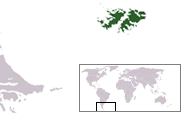
First, is to know where exactly the islands are. It’s in
the Southern Atlantic Ocean, 350-ish miles off Argentina. And as you can see
from the map below, there are two main islands, named East Falkland and West Falkland.
The Falklands comprise of about 300 islands.
In the 19th century the Falkland Islands
was colonised by the United Kingdom, which was fairly common because the UK at
that time was quite powerful and had many colonies overseas. Then there were
endless conflicts over the ownership of the islands between the UK and
Argentina which I wouldn’t mention because it’s complicated. And in the world
wars, the Falklands continued to be won over by the British army.
Problems emerged when the United Nations was founded
in 1945, right after the end of WWII. Argentina saw its creation as an opportunity to
pursue its claim of the Falklands. Negotiations between the two sides failed,
so the Falklands remained under British rule.
At the beginning of the 1980s Argentina faced economic
crisis, and the Argentinian government decided to invade the British-owned Falklands to regain its reputation. It started on 2nd April (today!)
1982. At first the UN was trying to persuade Argentina to have a negotiation
with Britain but she refused. Living 8000 miles away, British Prime Minister
Margaret Thatcher was determined to fight the Argentinian Special Forces. She said
the 1,800 Falklanders were "of British tradition and stock. So the British
sent their armies to the southern Atlantic.
The fight ended in June with British victory. Although
it was brief, it was bitter (BBC) - 655 Argentine, 255 British servicemen and 3
Falkland Islanders sacrificed their lives during the war.
The result was that the Conservative party of the UK
under the rule of Margaret Thatcher was much consolidated, and she herself has
gained much respect as the first female British prime minister. On the other
hand, Argentina gained nothing and her military government collapsed due to
their defeat. Today, the Falklands are still under British rule, with English
being the official language of the archipelago and inhibiting about 3000
people. But Argentina still claims the archipelago themselves. Doh.
And may I say that Thatcher’s decision to keep the
Falklands under British control was quite a wise one – a massive oil reserve
was discovered in 1998 near the Falklands which means that Britain’s energy
security in the future may be ensured. Although not quite intended for this,
well done Thatcher.